Indians are all crazy about sedans. That explains the sales proposition of sedans like the Maruti Swift Dzire and also the Toyota Etios. Speaking of the latter, the car buying public have been going bonkers, some even without test driving the car have gone forward and have put their money into it. Not only does the Etios appear a valuable investment, it also makes sense to go in for a Toyota rather than a Tata or even Maruti at almost the same price. In comes the long forgotten Mahindra Logan nee Verito. Mahindra have dropped the Renault motif and also the Logan name, so as to give the car buying public something new to cheer about. It was in the cards that these two boxy contestants lock horns in the Indiandrives battle arena and so here we are with the comparison of the Toyota Etios in India and the Mahindra Verito in India. Both entry level value for money buys (Toyota and Mahindra’s claims , not ours).
Looks
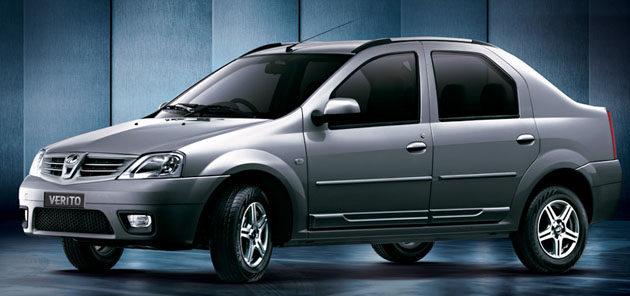
One word would describe both the cars and that is “boxy”. Both look like matchboxes on wheels. However the manufacturers certainly have done a lot to project both these cars in a different vein. While Mahindra now gives side claddings and fog lamps as standard while the Renault logo has been replaced with the Mahindra saber tooth logo. Mahindra have also ensured that this car comes with more features now than what Renault could provide at this price point. Just like the Toyota Etios, the new Mahindra Verito in India now features a chrome strip at the rear which more or less resembles that of the Etios. The tail lamps design is the same as that of the Logan and also features an inbuilt reversing light. A single one at that, pointing to the car’s foreign origins. There are alloys wheels on the top end version. There are also rear fog lamps and Roof rails or ski rack as they call it. The Toyota Etios in the meanwhile has a front chrome detailing as also a rear one. More of chrome follows on the top end version and there are alloy wheels and side skirts on offer too. The Etios has a similar tail lamp design but with reversing lights on both the ends. Traditional Toyota conservationism shows with the tail pipe hidden from view. 15 inch wheels are standard on both the cars. If you ask us to pick up a winner amongst them based on the looks, then it is very difficult. It is because both of them come from the same school of thought.

The Mahindra Verito in India gets a slight edge as far as the newer design is concerned. The Toyota Etios in India has been hugely inspired by the Mahindra Logan (will have to call it that since at the time of the Etios release, this car was still a Logan). Our vote goes for the Mahindra Verito but that is only by a slight margin.
Interiors
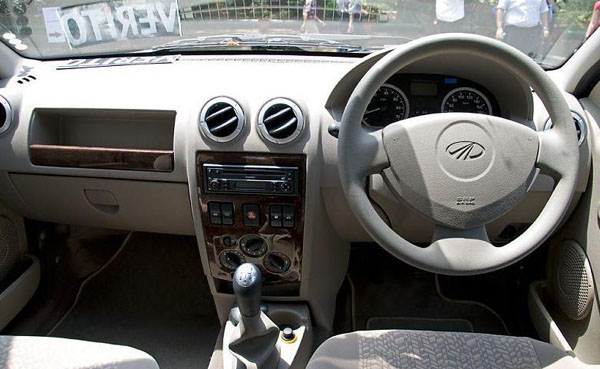
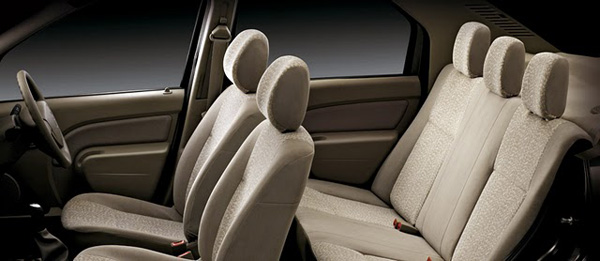
The Mahindra Verito in India gets a little bit cheerful interiors than the Etios. This is primarily due to the fact that Mahindra have used the beige theme for the upholstery. Getting into the driver’s seat for taller drivers is a bit of a hassle since the steering wheel still is non adjustable. However the front seat has manual adjustment and so finding a comfortable position isn’t a thing of bother. The instrument panel looks plain however once the lights come in, the panel feels very lively. However one would definitely notice that this car has European roots with the positioning of the indicator stalks and lights. Even the boot release mechanism is placed near the front passenger’s seat. The rear power window switches position is also a bit of an oddball, behind the parking brake lever. Cabin space however at the rear is massive. Not that the front is lacking in it but then rear seat passengers get a flat seat and enough shoulder room. The Logan however feels well put together. Coming to the Etios, ingress is a bit on the lower side however the steering wheel is tilt adjustable and finding a comfortable driving position isn’t a bit of bother. Moreover, the front driver’s seat has more travel to it than that of the Verito and hence adds to the comfort quotient. However the centrally placed instrument console wouldn’t be to everyone’s liking. The speedometer as also the tachometer with their white and strange blue background feel a bit odd and moreover the fonts also feel a bit difficult to read. The Etios has lots of cubby holders and as Toyota puts it, 10 cup holders. The door map pockets are also deep and generous. A perfect seat angle and also wider seat with lower central tunnel intrusion works to make this one of the best entry level sedan for the chauffer driven. The round AC vents are shared between the Mahindra Verito and also the Toyota Etios. However the design on both the cars is different. While the Toyota’s has more folds, the Mahindra’s displays similar trend like that of the Ford Figo. The quality of plastics used on the Etios however seemed a bit doubtful as also the garish red color for the upholstery and the gear lever knob. Boot space is massive by any standards on both the cars and would rival that of some full size SUVs. However both don’t have split seat arrangement. In the boot stakes, it is the Etios with its 595 liters boot space that stands out. The Mahindra Verito follows with its 510 liter boot, nearly a 100 liter deficit from that of the Toyota’s. Both the boots are pretty much easy to load and hence frequent airport trips or rather long outings would be warranted on these cars.
Surprisingly, the Mahindra Verito feels a bit more better built while the Etios claws its way back with the better space proposition. The Toyota Etios steals the edge over the Verito on this one with its better overall packaging and oodles of space.


Handling and ride quality
The stiff chassis coupled with the generous travel of the suspension shocks ensure that the Mahindra Verito in India possess a good ride quality. The ground clearance is also on the generous side and everything but the deadliest of the speed breakers would upset its composure. People who must have traveled in Meru cabs would definitely remember the Logan’s pliant ride quality. Since the underpinnings haven’t changed, the Verito by virtue of being a reskinned Logan gets the same ride quality. The handling is also pretty decent for a car which sacrifices the aerodynamics part in the interests of better interior space utilization. While the Logan may not exactly be a corner carver like the Swift Dzire, it delights by following the intended path of the driver. The steering wheel is also very direct and delivers a good timely feedback. It isn’t overtly light in the city but doesn’t feel as cumbersome either. The Toyota Etios in India gets a stiff suspension setup which cannot prevent the low speed bumps coming its way from entering the car’s cabin. The Etios has a much lighter steering wheel than that of the Verito however this steering wheel, like those of other Toyotas, is very much useful only in the city limits. It lacks a head on feeling and for most of the part feels lifeless. However the lower kerb weight and the steering lightness ensure that the Etios is a nimble car in the city. Inspite of its lower kerb weight, the Etios is pretty much very stable on the highway. Corner carving is not any Toyota’s forte and the Etios doesn’t look like it would bend any laws of physics anytime soon. It obeys the path or trajectory intended for it however with some pushing around. As far as NVH goes, the Renault motor is a bathroom singer while the Toyota one is an opera singer. Toyota have skimped out on adding enough damping material under the hood and hence the Etios is the more vocal one as far as NVH goes. The Renault motor however is pretty much silent in its operation and even in elevated speeds, it doesn’t feel strained.
The Mahindra Verito wins this round since we rate ride quality higher than the handling stakes. But surprise, the Verito even surprises us with its good show of handling prowess. The Etios is purely to be driven in low speeds given the amount of engine noise filtering into the cabin at higher speeds.
Engine, performance and fuel efficiency
The Mahindra Verito in India is the versatile of the two with a diesel and petrol motor on offer. However for the sake of being fair, we have compared the petrol motor of the Verito with that of the Etios. While the 1390 cc 4 cylinder engine of the Verito makes 75 Bhp of power and 11.21 kgm of power, the 1496 cc engine of the Etios makes 90 Bhp and 13.46 kgm of torque. Both these cars are mated with 5 speed manual transmissions. Both the cars boast of an excellent shift quality with the Mahindra’s having a very refined feel to it. The clutch setup is on the lighter side as well. However put pedal to metal and the capacity disadvantage comes into play. The Etios races from 0-100 kmph in only 11.4 seconds and attains a top speed of 180 kmph, the Verito in the meanwhile achieves the 100 kmph mark in a leisurely 16.2 seconds. The top speed is also way lower at 146 kmph. The Mahindra’s gear ratios are on the taller side and hence more prodding is needed while in the city. With a full complement of passengers and the AC in full swing, the Verito struggles to gain momentum. The Etios in the meanwhile gets better spaced ratios and feels equally at home in both the city and highway speeds. Both the cars are easy to drive, even for beginners due to the view from the bonnet and overall visibility.
As far as brakes are concerned, the Etios has the stronger pedal feel while the Verito’s feels a bit behind. Only on the higher specced variants, Mahindra offers ABS whereas Toyota offers it as an option from the middle variant. Both the cars however managed to accumulate safe braking distances in our books. The Verito still gets only a driver airbag while the Etios offers dual ones. However the Verito has proved its crash worthiness in different parts of the world whereas the Etios is yet to do that. As far as fuel efficiency is concerned, both the cars have similar figures with the Etios returning an overall 15.3 kmpl and the Mahindra coming to a stop in about 15.1 kmpl.
The Toyota Etios has a superior engine and capacity advantage. It is more fun to drive and at the same time is very fuel efficient. The Toyota Etios in India wins this round while the Mahindra Verito lacks behind in safety features.
Verdict
As far as the points tally rakes up, the Mahindra Verito in India is a winner. Mahindra have ensured that the cost cutting scenario which was quite associated with the Renault Logan is erased from the Indian customers minds. The Verito is now a family sedan and not one for the taxi buyers. It more or less does everything which Toyota’s baby does. However Mahindra have skimped on the safety aspect and instead should have given this car more of safety equipment. Also they could have reconfigured the stalks and indicators to suit Indian styles. Speaking of Indian styles, the Toyota Etios in India is no less configured only for India. The centrally mounted instrument panel shows that this car would eventually be exported. Cost cutting measures are more evident in the Toyota than in the Mahindra. The Toyota lends a solid punch with its much superior engine and safety features. Plus it has a massive boot which can swallow a Tata Nano. The Mahindra Verito however is a better buy since it has a choice of petrol or diesel engines. That is until the 1.4 liter diesel from the Corolla Altis finds its way under the hood the Etios, much later this year. The Mahindra Verito price in India starts from Rs 4.82 lakhs and culminates at Rs 6.48 lakhs. The Toyota Etios price in India starts from Rs 4.96 lakhs and ends at Rs 6.86 lakhs. All these prices are ex-show room, Thane. The Verito is offered with a 2 years / 50000 kms warranty, which can be extended to 2 years more. Toyota however offer only 3 years or 100,000 kms, whichever comes earlier warranty.
Our winner of this comparison is the Mahindra Verito.




Leave a Reply